Java高级-Lambda表达式
Lambda表达式
Lambda语法
JDK8开始支持Lambda表达式,用来让程序编写更优雅
利用Lambda可以更简洁的实现匿名内部类与函数声明与调用
基于Lambda提供stream流式处理极大简化对集合的操作1
2
3
4
5// Lambda表达式简化代码
List<String> list = Arrays.asList("Cfa","Dsadsa","Adahhd","Adsads");
// JDK1.8后List类新增sort()方法,和Collections类中的sort()方法一致
// JDK1.8之后,Collections.sort()方法也是调用的List.sort()方法
list.sort((a, b) -> a.compareTo(b));语法
(参数列表) -> 实现语句
参数列表:使用逗号分隔参数,参数类型可省略,单参数括号可省略。
实现语句:单行直接写,多行用{}包括。
约束条件:Lambda表达式只能实现有且只有一个抽象方法的接口,Java称为”函数式接口“。
1
2
3
4
5
6
7
8
9
10
11
12
13
14
15
16
17
18// 标准Lambda使用方式
MathOperation add = (Integer a, Integer b) -> {
System.out.println("加法运算:"+a + "+" + b);
return a + b + 0f;
};
float operate = add.operate(1, 3);
System.out.println("运算结果:"+operate);
// 允许忽略参数类型
MathOperation sub = (a, b) -> {
System.out.println("减法运算:"+a+"-"+b);
return a - b + 0f;
};
System.out.println("运算结果:"+sub.operate(5, 3));
// 单行实现可以省略大括号和return关键字
MathOperation mult = (a , b) -> a * b + 0f;
System.out.println("运算结果:"+mult.operate(3, 5));
函数式编程
函数式编程是基于函数式接口并使用lambda表达的编程方式。
函数式编程理念是将代码作为可重用数据代入到程序运行中。
函数式编程强调”你想做什么”,而不是“你想怎么做” 。JDK1.8后提供了一系列新的函数式接口,位于java.util.function包下
例子(Predicate函数式接口)
函数式接口Predicate,用于测试传入的数据是否满足判断要求,实现test()方法进行逻辑判断。
1
2Predicate<Integer> predicate = a->a>4;
System.out.println(predicate.test(5));1
2
3
4
5
6
7
8
9
10
11
12
13
14
15
16
17
18// 通过函数式编程获取list数组中满足条件的数据
public static void main(String[] args) {
List<Integer> list = Arrays.asList(1,2,3,4,5,6,7,8,9,10);
// 获取List数组中偶数
PredicateSample.filter(list, a->a%2==0);
// 获取List数组中奇数
PredicateSample.filter(list, a->a%2==1);
// 获取List数组中大于5的偶数
PredicateSample.filter(list, a->a>5 && a%2==0);
}
public static void filter(List<Integer> list, Predicate<Integer> predicate) {
for (Integer num : list) {
if (predicate.test(num)) {
System.out.println(num);
}
}
}JDK8中常用函数式接口
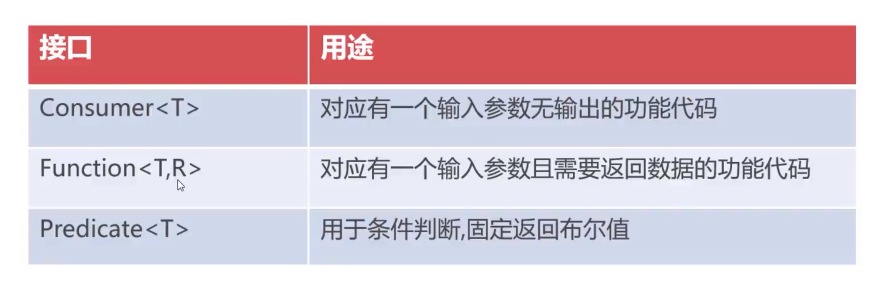
Function函数式接口使用
1
2
3
4
5
6
7
8
9
10
11
12
13
14
15
16
17
18
19
20
21
22
23
24
25
26/**
* 利用Function返回一个随机定长字符串
* 通常用于加密、解密操作
*/
public class FunctionSample {
public static void main(String[] args) {
// 定义一个小写数字字符串
String chars = "abcdefghijklmnopqrstuvwxyz0123456789";
// 定义一个StringBuffer用于存储生成的随机定长字符串
StringBuffer sb = new StringBuffer();
// 定义一个Random用于生成随机数
Random random = new Random();
Function<Integer, String> function = l->{
// 循环返回的字符串长度l
for (int i = 0; i < l; i++) {
// 生成一个随机字符串的位置参数i1(随机数范围为chars的长度)
int i1 = random.nextInt(chars.length());
// 将该字符追加到StringBuffer数组中
sb.append(chars.charAt(i1));
}
return sb.toString();
};
String apply = function.apply(8);
System.out.println(apply);
}
}函数式注解
@FunctionnalInterface:通知编译器这是函数式接口,进行抽象方法检查。
函数式变成与面向对象变成比较
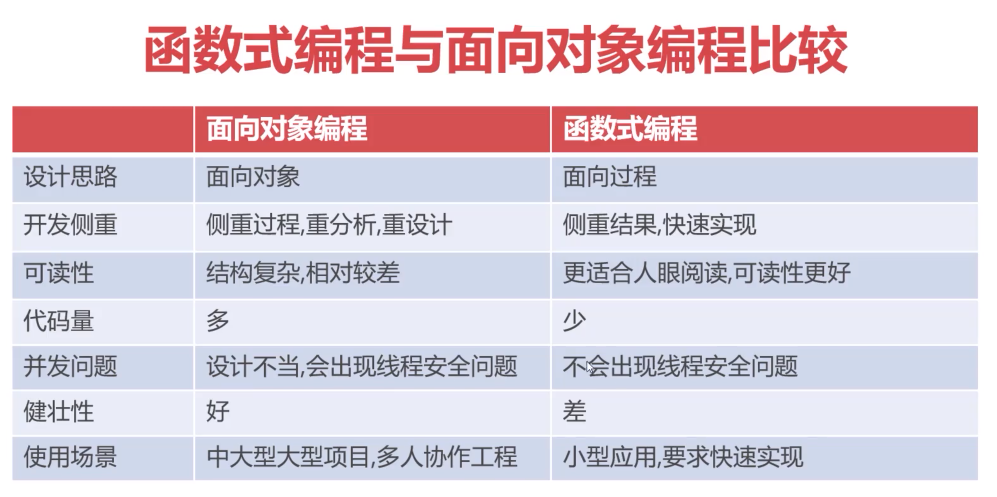
Stream流式处理
Stream流式处理是建立在Lambda基础上的多数据处理技术。
Stream对集合数据处理进行高度抽象,极大简化代码量。
Stream可对集合进行迭代,去重,筛选,排序,聚合等一系列处理。1
2
3
4
5
6// 获取List集合中最大的偶数
Optional<Integer> op = Arrays.asList(1,2,3,4,5,6).stream()
.filter(x->x%2==0)
.sorted((a,b)->b-a)
.findFirst();
System.out.println(op.get());Stream常用方法
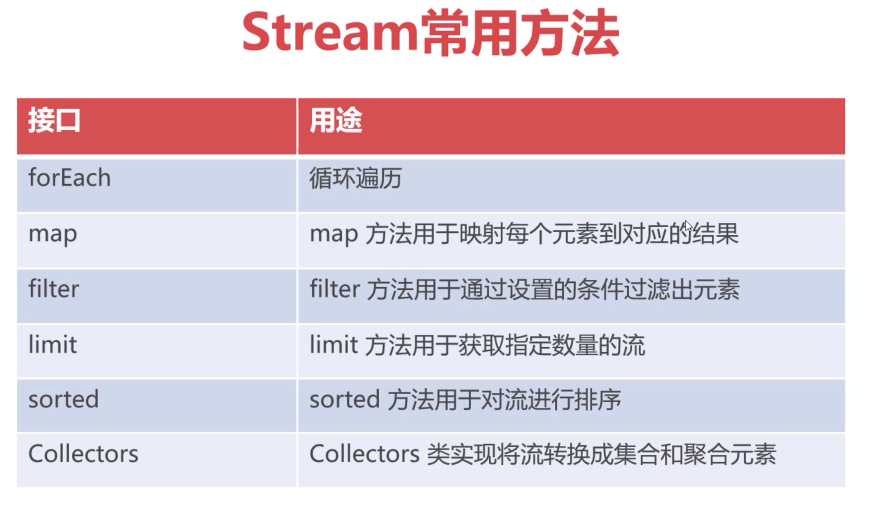
基于数组创建
1
2
3String[] arr = {"A","B","C","D"};
Stream<String> arr1 = Stream.of(arr);
arr1.forEach(s-> System.out.println(s));基于集合创建
1
2List<String> list = Arrays.asList("A","B","C","D");
list.stream().forEach(s-> System.out.println(s));基于generate方法创建无限长度流
1
2Stream<Integer> generate = Stream.generate(() -> new Random().nextInt(10));
generate.limit(5).forEach(i-> System.out.println(i));基于迭代器创建流
1
2Stream<Integer> iterate = Stream.iterate(2, i -> i + 1);
iterate.limit(5).forEach(i-> System.out.println(i));基于字符序列创建流
1
2
3String s = "abdsad我的";
IntStream chars = s.chars();
chars.forEach(c-> System.out.println((char)c));案例1:提取集合中所有奇数并求和
1
2
3
4List<String> list = Arrays.asList("1", "2", "3", "4", "5", "6", "7", "8", "9");
// mapToInt将流中每一个数据转为整数
int sum = list.stream().mapToInt(s -> Integer.parseInt(s)).filter(i -> i % 2 == 1).sum();
System.out.println(sum);案例2:所有名字首字母大写
1
2
3List<String> list = Arrays.asList("tom", "lili", "whale", "shanshan");
List<String> collect = list.stream().map(s -> s.substring(0, 1).toUpperCase() + s.substring(1)).collect(Collectors.toList());
System.out.println(collect);案例3:将所有奇数从大到小排序,且不允许出现重复
1
2
3
4List<Integer> list = Arrays.asList(1,3,2,4,8,2,1,32,5,7,0,9);
// distinct()去除重复流数据
List<Integer> sorted = list.stream().distinct().filter(s -> s % 2 == 1).sorted((a, b) -> b - a).collect(Collectors.toList());
System.out.println(sorted);
本博客所有文章除特别声明外,均采用 CC BY-NC-SA 4.0 许可协议。转载请注明来自 CodeWhale-Blog!
相关推荐



评论